Daniel Knecht

Stacking the deck in your favor

  • Working on building Artificial Intelligence seems all the rave these days. We build and leverage these systems to do our most basic thinking, believing unequivocally that it will displace the job market and help humanity engage in more meaningful activities. Without a doubt, automation is an important factor in enabling the cultivation of higher value output, but drive, innovation, and self-actualization are fundamental to a life that is full of meaning and fulfillment. There is a great problem with outsourcing human intellect by raising AI to great and all-powerful pedastools. Rendering them into God-like status that no mind could ever compete with.

    What if… our own intelligence is untapped. What if we are so nascent in the evolution of the brain that we haven’t even begun to realize what we can actually grow in terms of the potential of the mind. Take for example the extraordinary ability of savants like Kim Peek who could read two pages at once in seconds with near 100% perfect recall of every word and phrase. Our brains evolved with highly complex structures that have enabled us to understand the nature of reality, observe quantum phenomena, build particle colliders, discover nuclear fusion, and launch people into space and land on the moon. Many of these discoveries occurred thanks to the genius of only a fraction of people who embarked on difficult journeys of introspection, intense study, and prolific writing.

    The potential of our own intelligence is largely untapped by the masses. Savant-like abilities are possible when we dare to explore the unlocked fields of the subconscious and learn how to wield our own neural-networks. Nikola Tesla was able to build models in his mind’s eye so vividly, they were undistinguishable from real objects around him – I imagine how trivial and unremarkable he would find current AI systems compared to his own imagination. AI superintelligence becomes laughable when human superintelligence is taken to its ultimate expression – which is as infinite as the known and observable universe of 100-200 billion galaxies. There is a force of nature that allows us to evolve the brain because we are tapped into a universal mind. AI will forever be an isolated node, untethered to this greater power. There is a claim that Artificial Superintelligence will solve all the world’s problems. Given how few people already attempt develop their own superintelligence – we are investing in an unknown, unproven, and largely unpredictable dystopian future, when there is much better bet right between our ears that has been shown to actually solve real-world problems.

    Regardless of what big corporations try to force-feed us; there has been no better time in history to double down on unlocking and growing our own faculties and genius.
  • The risk of building systems and habits

    There is a common fallacy that exists in claiming that while discipline is useful, just build habits or systems instead and you never have to think about using your willpower again. All you need is a little bit of willpower at the beginning and voila, solved.

    I have found this to be true only so long as all the right environmental factors are in place to support that new habit. But what happens when you are overly reliant on habits you built 5 or 10 years ago and suddenly something drastically changes in your environment, stopping the habit loop right in its tracks? You will find yourself floundering…

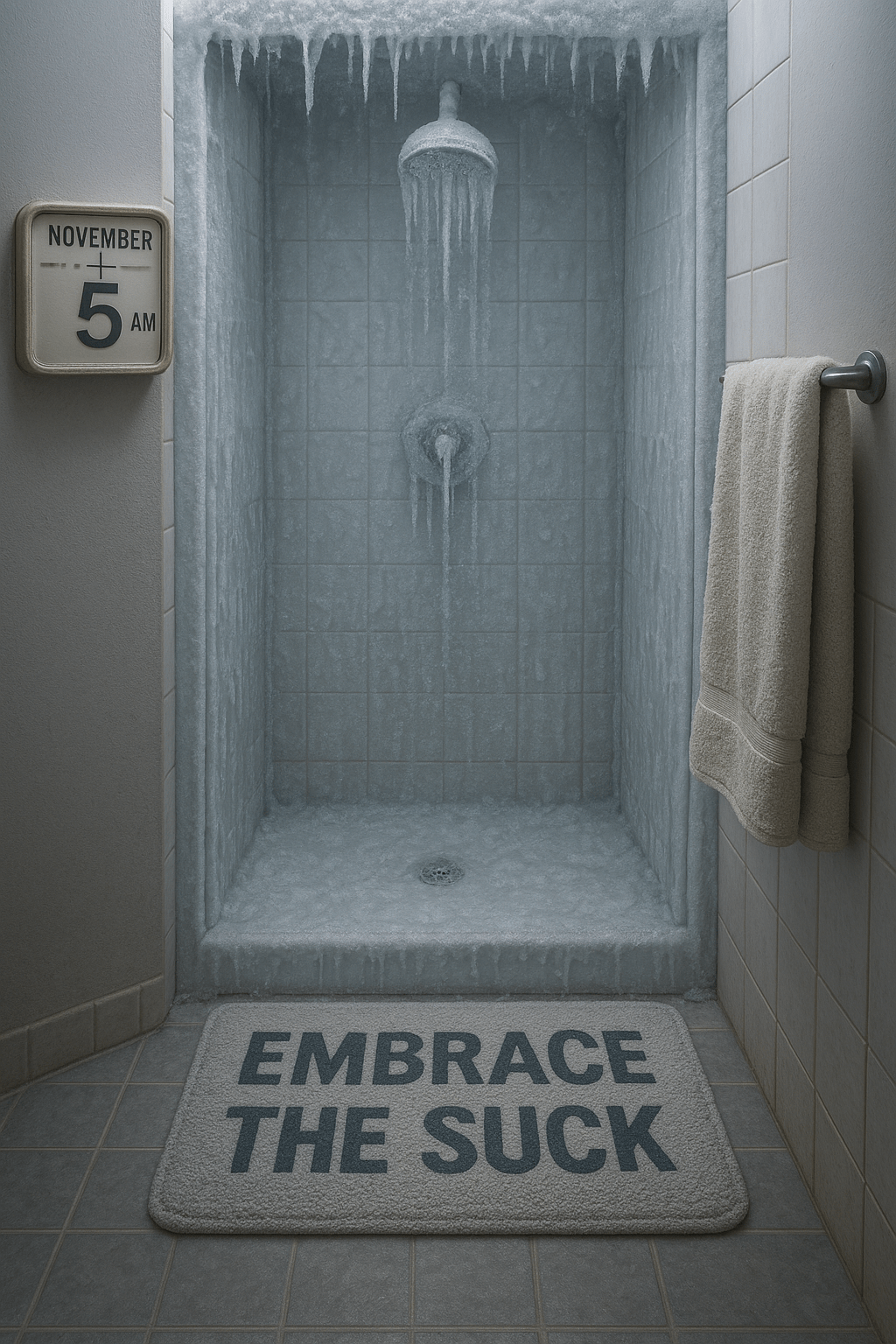
    While deliberate habit formation is an incredibly important skills to master, one must remain vigilant and keep your decision muscles alive and active every single day. Pick something you absolutely hate doing, and endeavor to make that thing a part of your life. Maybe its planking. Right now, I hate turning the water to freezing temperature in my shower in the middle of November at 5AM, but I know that I need to do it in order to develop the reflex and trust that in the event my habits fail due to a broken habit chain variable (cue, craving, action, reward), I will have enough baseline battery juice to install a new habit – which requires many days of sustained effort before becoming automatic. Another approach to this could be to consistently add new habits or modify existing ones on a monthly or quarterly basis. This ensures the muscle needed to build the habit to begin with never atrophies. Some people embark on 30-day challenges to practice this skill as well. Just be sure you have a new challenge when the 30-days are up.

    The more your practice doing things you hate, the stronger the capacity to stay consistent on any long-term task grows within you. Back in college, I did interval HIIIT running 6 days per week in the AM for between 30-40 minutes on the treadmill. During these sessions, I would run at a high speed and feel the lactic acids burning in my legs and stomach. I would do 7-8 intervals for up to 1 minute of sprints for each repetition. My mind would scream at me to stop but I would push onwards. This was never a habit. I was unintentionally training the foundation of ability we all need to install new habits. This practice was how I was able to stay consistent on my training for 6 months. Only in retrospect, many many years later do I realize why it was effective.

    Before embarking on any self-improvement in your life, practice one thing daily that you hate to do. It can be 5 minutes or less even. Expand your tolerance over time. If you can get to the level of sustained physical and emotional discomfort for 5-10 minutes on one thing you hate but know is good for you, any goal becomes 10,000% more attainable.

    Embrace the suck. This is highly individual. You might love ice cold showers or HIIT training, if you love it, that’s great, I’m proud of you, but that is not the thing you must choose.

  • Brain over Binge and AVRT

    Suffer from binge eating, excessive alcohol consumption, or compulsive ABCDEFG__________?

    One simple idea ended years of binge eating for Kathryn Hansen, who tried every therapeutic and psychiatric recommendation given to her. This was thanks to the pioneering work of Jack Trimpey, who wrote Rational Recovery to provide a solution for those who failed to recover from alcoholism through traditional programs and therapy.

    The idea is simple but profoundly life-altering. You can apply this technique not just to alcohol consumption, but also to uncontrollable fast-food binges or excessive doom scrolling on your phone.

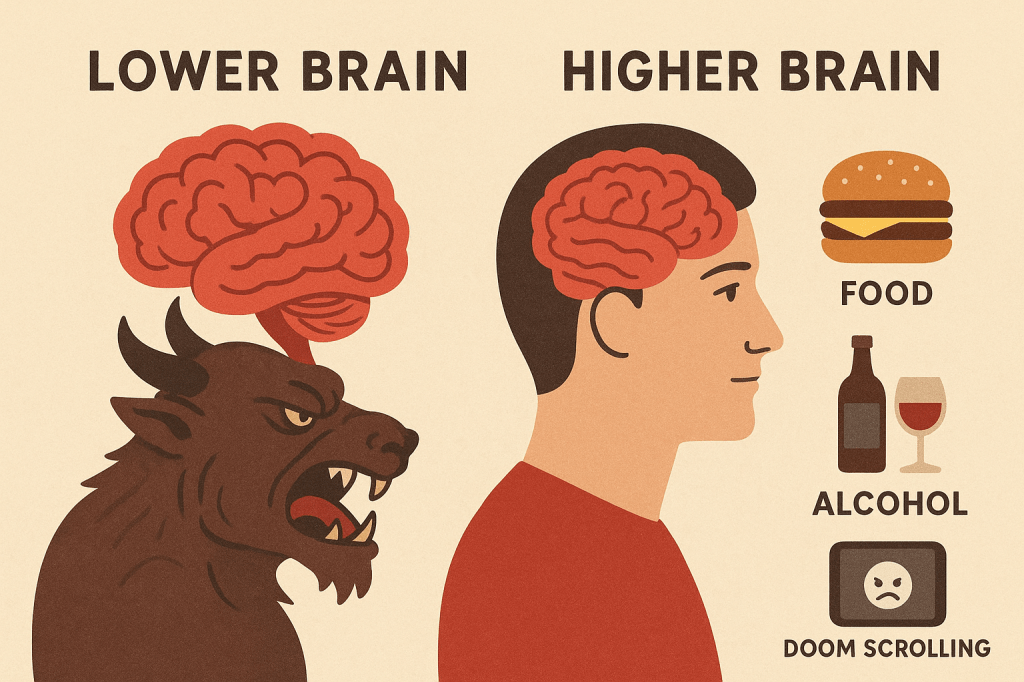
    In a nutshell, our brains are subdivided into various regions that govern every action, thought, and feeling, down to our very will to live. The brain evolved with a higher-order thinking mechanism that makes us distinct from animals: the neocortex, especially the prefrontal cortex located at the front of it. This higher mind is the seat of consciousness. Our ability to weigh decisions, wake up at 5 AM when the alarm goes off, or organize our to-do list for the day comes from this region. This higher mind is essentially your identity. It is the real you.

    Deep in the brain lies the limbic system. It is broken down into subregions that are far older in our evolutionary history. These structures evolved to ensure survival by governing hunger, emotional urges, desires, fears, pain, and pleasure. Without getting too neuroscience heavy, we can view this region as the animal brain, or the beast brain. It is necessary for survival and gives us cues to eat when hungry or drink when thirsty, all mediated by automatic processing beneath conscious awareness.

    In compulsive disorders like alcoholism, binge eating, or doom scrolling, the problem is identification with the wrong brain. The higher mind, the real you, has the ability to override the animal brain. This is why meditation is so powerful for improving focus and life in general. When you meditate, you sit with impulses to eat, drink, or do anything other than remain still for twenty minutes. Practicing awareness activates the prefrontal cortex, and awareness itself is learning to separate from the animal brain.

    The second important thing to realize is that the animal brain is not very smart. It often becomes irrational and destructive. A child bitten by a dog may develop a generalized fear of all dogs. A family tradition that once brought comfort can produce a lifelong emotional association. One intense experience, positive or negative, can create a deep neurological pathway that solidifies through repetition. This is why the simple thought of eating a slice of pizza can fire up the pleasure centers of the animal brain. It sends a signal that I imagine like a tennis ball being tossed in the air. At the apex, you have a choice to hit the ball or let it fall back down.

    AVRT, Addictive Voice Recognition Technique, teaches that this voice is what lobs the tennis ball of desire or fear up to the higher mind. It is sneaky and tries to convince you that your survival depends on eating the pizza. It insists that you will squash the anxiety or discomfort by giving in. It tells you that you deserve it, that it is only a slice, that you should live a little. This voice is massively deceptive, and the urge that it will protect your survival was formed without your conscious input.

    The same process applies when you compulsively reach for your phone. Your animal brain insists that you need to look at it to experience pleasure or fix boredom, loneliness, or anxiety. Once you recognize this addictive voice for what it is, you no longer need to follow it. For a split second, notice that the part of you deciding whether to eat the pizza or not is your higher mind. The lower brain may throw a small tantrum. Get curious about the sensation. Watch it from your higher mind. Something remarkable happens: the pangs pass, and you are left unharmed.

    The number one predictor of success in life is the ability to delay gratification. When you understand the lower brain’s signals and consciously choose how to respond, your binge eating problem begins to fade.

    I highly recommend listening to the audiobook or buying Brain Over Binge for more context than I can include in this short post.

    See you at the top.

  • 280 quintillion

    John von Neumann once calculated that the brain could hold 280 quintillion bits of information. That’s 280,000,000,000,000,000,000. More recent research suggests the number is in the trillions rather… It’s still a lot!

    In The Einstein Factor by Win Wenger, Ph.D., Dr. Wenger discusses a method that can be used to access the vast archives of the mind. For those of you interested in brain exercises that purport to increase intelligence, one such method detailed extensively in the book is called image streaming. The name is a bit of a misnomer as image streaming would more aptly be termed multi-sensory streaming as it involves the processing of taste, touch, smell, feel, and imagery. Having read the read the book a few times before, it never dawned on me how important this difference is to employ the technique successfully. All five senses are required. Dr. Wenger references A.R. Luria’s work from Mind of Mnemonist where his patient “S” has perfect memory recall of every word, phrase, and event – even to the extent of remembering a massive matrix of nonsense syllables 8 years later. S was able to accomplish these feats involuntarily by an automatic enmeshment of sensory impressions tied to each sound. Synesthetes are well known to possess this sort of superhuman memory ability where taste, color, touch, smell, and sound often get paired together when contemplating a word or sound. A meshing of senses that massively increases both the creation of memory as well as its future recall. Intuitively, what is happening in the brain is a process by which memory is encoded using much greater number of neurons, firing and wiring them together in such a way that makes them much stickier.

    Fast forward to the image streaming technique. Without getting into the details, our brains squelch an enormous number of bits of data every moment from all number of our sensory inputs. Some of the information gets encoded, others pass through. We also operate simultaneously at a conscious, subconscious, and unconscious level. Conscious awareness can only track so many things at once, beneath our perception we are breathing, our hearts are beating, our organs are operating efficiently, but we are also perceiving things such as non-verbal communication outside of our awareness. Our brains are filtering this information through networks of meaning via the trillions of synapses between neurons. Intuition, dream recall, and invention taps into these networks without conscious intervention. Image streaming provides the mean to tap into an enormous supercomputer between your ears.

    Ask a question, then close your eyes and describe out loud to a tape recorded or friend what images, sounds, tastes, feelings, colors come to mind. If you see a mountain, how does it taste, what does it feel like, is there a soft wind blowing or a strong gust or storm? The technique needs no more than 10 minutes to derive enormous benefits. Once you have the information captured, you can analyze the imagery to figure out what your subconscious is trying to tell you. Forget about asking AI for advice on what you should eat for dinner, why not try asking your subconscious supercomputer instead?

  • Welcome to WordPress! This is your first post. Edit or delete it to take the first step in your blogging journey.

  • I hardly recognize the world around me. When I was younger, life was simpler. For those of you who were around in the 90s and early 2000s, you might recall a time before smartphones. A time before AI and LLMs came to mean the same thing. I can’t say that life was easy, but it wasn’t so complicated. The advent of technology promised boundless freedom, the world at your fingertips, every draw of the digital roulette wheel a chance to “make it”. The internet was new and exciting. Authenticity reigned supreme and YouTube was an opportunity that gave enormous reach and power to individuals and away from massive corporate wealth and monopolistic control of information and entertainment. Blog posts gave voice to content creators with something important to say. Every good thing has its limits though, and fast-forward to the 2020s, it has become clear to me that boundaries must be set, and a new philosophy of personal success must be considered. The variables comprising the equation of life mandate a new approach to mitigate the worst parts of this brave new world.

    Enter stage: this web log.

    I have decided to counter the culture with a guide for anyone who dares redefine what it means to be human. This site will serve as a place to reflect on priorities. Explore together the strategies to awaken from your deep hibernation and to fire back up the prefrontal cortex and quiet the monkey mind. Distraction and ossification of willpower are the currencies of modern society. Our attention, critical thinking, and resolve has suffered major blows thanks to the way technology has evolved. It is now more essential than ever to find balance and live with intention.

    Technology is not inherently good or evil. Scientific discovery has helped society overcome the extreme harshness of life. Shelter from the elements, abundance of food in developed countries, access to medical care that renders pain and suffering manageable, extending the years of life far beyond what our ancestors could have imagined was possible. The point I want to make is, the mind left to its own devices is like a garden left without care, it grows impossible to manage weeds and becomes unkempt and disheveled. Muscles left without exercise atrophy and lose their strength. Similarly, left untended; willpower, critical thinking, and navigating the journey of life without a map, without practices that strengthen our most powerful tool – mind, body, and spirit, will lead to the dulling effect that renders us slave to dopamine, attention-grabbing stimuli, and slothful indulgences and comforts. It has a ruinous effect.

    So how do we combat the dangers of this new landscape? It begins by becoming aware of the deleterious effects, to begin to feed the mind with a counter-narrative, a recognition that it is possible. Shape our core beliefs and our personal environment to strengthen those attributes which lead to true freedom. Instill new habits, new behavioral patterns that rewards doing the hard things. Embracing and facing fear and discomfort as a new default-mode. The depth of comfort in the modern era is profound, and therefore the depths we must go to balance the scale is quite deep as well.

    Today, I started my day at 4:00AM. Went to the gym, did dual n-back training, took an ice-cold shower, spent 30 minutes reading The Einstein Factor by Win Winger, Ph.D., and spent some time writing this web log. I plan to leave my smartphone in the kitchen today, to reduce the pull of distraction. Yes, it’s boring. Yes, it’s not fun. But, It’s necessary.

    See you at the top.